

Best Night Vision Scope for .223 Remington options are widely valued because they extend shooting capability into low light and nighttime conditions while improving target detection, clarity, and overall field performance on a lightweight, low recoil rifle platform. These scopes are particularly effective on .223 Remington setups because they help maintain accuracy and visibility during dawn, dusk, and full darkness without compromising handling or stability.
In this guide, you will find a clear breakdown of the most important features that matter in real use, a selection of top-performing options, a practical buying guide, and frequently asked questions. The goal is to separate meaningful performance from marketing claims so you can understand what actually works in the field and what creates unnecessary complexity.
5. Best Night Vision Scope for .223 Remington
1. Armasight Vulcan 4.5X Magnification Night Vision Rifle Scope
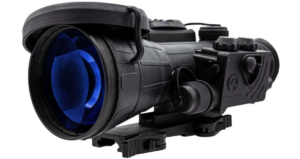
The Armasight Vulcan 4.5x Gen 3 Bravo Ghost White Phosphor Night Vision Riflescope sits in a completely different category from the digital optics reviewed earlier. This is not a hybrid system, not a recording device, and not a smart scope. It is a dedicated Gen 3 image intensifier night vision optic, and for a .223 Remington platform, that difference is more important than any spec sheet comparison.
This scope uses a Gen 3 white phosphor image intensifier tube, which is fundamentally a different technology from CMOS based digital night vision. Instead of capturing and processing light through software, it amplifies available light in real time. The result is a more natural, continuous image with no screen delay and no digital processing artifacts. For shooting scenarios, especially moving targets in low light, this immediacy is a major advantage that digital systems cannot fully replicate.
The 4.5x fixed magnification is intentional and reflects the philosophy of traditional night vision design. There is no zoom range because optical consistency and clarity are prioritized over flexibility. On a .223 Remington rifle, this makes it more suited to controlled engagement distances rather than variable range scanning. It performs best when the shooter already understands distance and environment rather than relying on magnification to solve identification problems.
Manual gain control and an independent illuminated reticle allow the user to adjust brightness and contrast directly. This is a critical advantage in varying light conditions, especially when moving between open terrain and darker environments. Unlike digital systems that automatically process brightness, this gives the shooter direct control over image behavior, which tends to produce more predictable results under stress.
The system includes protective features such as automatic shutdown under excessive light exposure, which is essential for preserving the image intensifier tube. This is not a convenience feature, it is a survival mechanism for the device. Without it, a momentary exposure to bright light could permanently damage the tube, which is one of the tradeoffs of Gen 3 technology.
It also supports IR accessories via tactical rails, allowing external illuminators to enhance performance in complete darkness. However, this introduces dependency on additional gear, which increases system complexity compared to simpler daylight optics or integrated digital systems.
At 2.4 pounds, it is heavier than basic scopes but still within manageable range for a .223 Remington rifle setup. The aluminum construction and nitrogen purging improve durability and fog resistance, making it suitable for real field conditions rather than controlled environments.
Key Specifications
- Image intensifier Gen 3 Bravo white phosphor IIT
- Magnification 4.5x fixed
- Objective lens multicoated all glass optics
- Reticle illuminated with adjustable brightness
- Power source AA or CR123A battery
- Mounting Picatinny rail system
- Weight 2.4 pounds
- Construction aluminum housing
- Weather resistance waterproof and nitrogen purged
- Accessories support IR lasers and illuminators
- Safety auto shutoff for bright light protection
- Remote activation control included
Pros
- True night vision with real time light amplification and no digital delay
- Superior motion clarity compared to digital night vision systems
- Gen 3 white phosphor provides high contrast and reduced eye fatigue
- Manual gain control allows precise image adjustment
- Strong durability with fog and weather resistance
- Reliable performance in deep low light conditions
Cons
- Requires careful handling due to sensitivity of image intensifier tube
2. AGM Global Vision Spectrum LRF 4K Digital Day & Night Vision Rifle Scope
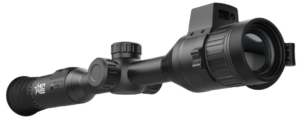
The AGM Global Vision Spectrum LRF 4K Digital Day and Night Vision Rifle Scope is positioned as a high capability optic for .223 Remington platforms, especially for users who want digital imaging, range finding, and recording in one system. It tries to replace multiple pieces of gear with a single unit, but that ambition comes with both real strengths and clear compromises that matter in the field.
This scope uses a 4K UHD CMOS sensor paired with an OLED display, which gives it a strong advantage in clarity compared to older digital night vision systems. In daylight it performs close to a high quality digital spotting device, and in low light it stays usable without immediately collapsing into grainy output. For .223 Remington shooters who often operate in mixed lighting, dawn, dusk, or shaded terrain, this flexibility is practical rather than theoretical.
The integrated laser rangefinder rated up to 1,000 meters is one of the more serious functional additions. Combined with the internal ballistic calculator, it reduces the mental load of estimating distance and adjusting holdovers manually. In real shooting conditions, especially for hunters or precision shooters, this reduces errors that typically come from rushed range estimation. However, relying heavily on electronic correction also means the system becomes less forgiving if batteries fail or if the software interpretation is slightly off.
Magnification runs from 3.5 to 28 times, which makes it adaptable for both mid range scanning and more focused target identification. The adjustable aperture from F1.2 to F2.5 helps it pull in more usable light during low light hours, but this is still digital imaging, not true optical night vision, so motion clarity can degrade compared to premium analog systems when tracking fast movement.
Recording capability is another strong point. The onboard video and audio capture, including shot activated recording and 64GB internal storage, turns the optic into a documentation tool as much as a sighting device. Wi Fi connectivity through the AGM app makes sharing straightforward, but this also introduces dependency on firmware stability and app performance, which is often where digital optics can become frustrating over time.
Power is handled through a dual system with internal and replaceable batteries, delivering up to 11 hours. That is solid, but in extended field use it still requires planning. The waterproof, shockproof, and recoil rated construction makes it suitable for .223 Remington recoil levels without concern.
Key Specifications
- Sensor type 4K UHD CMOS digital sensor
- Display OLED screen
- Magnification 3.5 to 28 times
- Laser rangefinder up to 1,000 meters
- Ballistic calculator built in
- Aperture F1.2 to F2.5 adjustable
- Storage 64GB internal
- Battery system dual internal plus replaceable battery
- Battery life up to 11 hours
- Connectivity Wi Fi with mobile app support
- Mounting ring mount compatible with rifles
- Weight 1.2 kilograms
- Material polycarbonate housing
- Weather resistance waterproof and shockproof
Pros
- Very strong image clarity for a digital night vision system
- Accurate integrated rangefinding up to long distances
- Useful ballistic calculation reduces guesswork
- Wide magnification range suits multiple shooting roles
- Good low light performance for dawn and dusk use
- Built in recording with solid storage capacity
- Rugged build appropriate for field recoil and weather exposure
- Flexible power system reduces risk of sudden shutdown.
Cons
- Heavy reliance on electronics introduces failure points in critical situations
3. GOYOJO Thermal Scope for Rifle
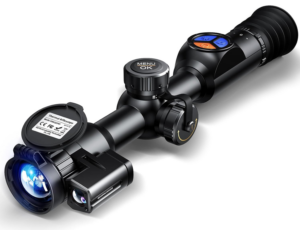
For hunters searching for a capable optic for nighttime use, the GOYOJO Thermal Scope for Rifle combines thermal imaging, practical magnification, ballistic functions, and multiple display options in a modern digital riflescope. Unlike conventional night vision optics that depend on visible or infrared light, thermal imaging detects heat signatures, allowing the scope to produce usable images in complete darkness as well as challenging conditions such as fog, brush, and low-contrast terrain.
The scope is available with different thermal configurations, including 256×192 and higher-resolution options. The 12μm thermal sensor is designed to provide improved image detail and target definition, helping hunters distinguish heat signatures more effectively during nighttime observation. This makes the scope particularly useful when conventional optics have difficulty producing a clear image.
Another important feature is the combination of true optical magnification and digital zoom. The scope provides 3.5x optical magnification, followed by 1x to 8x digital zoom depending on the selected configuration. Using optical magnification as the foundation helps maintain a clearer image before digital enlargement is applied, providing greater flexibility when observing targets at different distances.
The GOYOJO also incorporates smart ballistic functionality. Users can enter relevant ballistic information such as bullet velocity and wind conditions, while the system combines this information with distance measurements to calculate a holdover. This can simplify aiming adjustments when hunting at different ranges. LRF-equipped versions are also available for models that include integrated distance measurement.
Image customization is another useful feature. Depending on the model, users can select from multiple reticle designs, reticle colors, and thermal color palettes. With up to 10 reticle styles and seven thermal palettes, the display can be adjusted according to terrain, lighting conditions, and personal preference. The 50/55Hz refresh rate also helps provide smoother image updates when scanning or tracking moving targets.
Durability is supported by an IP67 waterproof rating and recoil resistance rated for demanding rifle platforms. The scope is designed to handle recoil loads up to 800 g / 0.4 ms and can be used on platforms ranging from AR-style .223 rifles to .308 hunting rifles. A diopter adjustment from -5 to +5 allows users to fine-tune the display for their eyesight.
Key Specifications
- Brand: GOYOJO
- Product Type: Thermal Rifle Scope
- Thermal Resolution: 256×192 and higher-resolution models available
- Thermal Sensor: 12μm
- Refresh Rate: 50/55Hz
- Optical Magnification: 3.5x
- Digital Zoom: 1x to 8x
- Ballistic Calculator: Supported
- Rangefinder: Available on selected LRF models
- Reticle Options: Up to 10 styles
- Reticle Colors: Multiple options
- Thermal Color Palettes: 7
- Recoil Rating: Up to 800 g / 0.4 ms
- Weather Resistance: IP67 Waterproof
- Diopter Adjustment: -5 to +5
- Compatible Platforms: AR-style .223 and .308 hunting rifles
- Recording: Recoil-activated video
- Accessories: Charger, mount, and extended eye cup
Pros
- Thermal imaging works in complete darkness and challenging visibility conditions
- 12μm sensor provides detailed thermal target definition
- 3.5x optical magnification provides a clearer base image before digital zoom
- Smart ballistic functions simplify holdover calculations
- Multiple reticles and thermal color palettes provide display customization
- IP67 waterproof construction improves all-weather reliability
Cons
- Higher-resolution and LRF configurations can be considerably more expensive
4. ATN X-Sight 4K Pro Smart Day/Night Hunting Scope
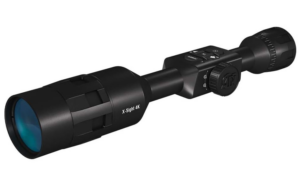
The ATN X-Sight 4K Pro Smart Day/Night Hunting Scope is a feature-rich digital optic designed for hunters who want high-resolution imaging, enhanced nighttime visibility, and smart shooting functions in a single scope. For users searching for a capable optic for a .223 Remington setup, it combines a high-resolution digital sensor with an integrated ballistic calculator and recording system, making it considerably more advanced than basic digital day and night scopes.
The scope uses an Ultra HD 4K sensor with a 3864 × 2218 resolution and an Obsidian 4 dual-core processor. This combination is designed to deliver detailed digital imagery during daytime use while maintaining useful visibility when lighting conditions become challenging. The enhanced night vision mode extends the scope’s usability into low-light environments, allowing hunters to transition between day and night viewing without replacing the optic.
One of the most useful features for shooting applications is the built-in ballistic calculator. The system can factor in information such as range, wind, and shooting angle when calculating ballistic solutions. This provides additional data directly through the digital optic and reduces the need to rely entirely on separate external ballistic tools.
The X-Sight 4K Pro also incorporates dual-stream video recording. Footage can be recorded simultaneously to a mobile device and Micro SD card, while recoil-activated recording provides a convenient way to capture shooting footage automatically. This makes the scope useful for hunters who want to document their outdoor sessions without adding a separate recording device.
The included ATN Quick Detach Mount is another practical feature. Constructed from hardened aluminum alloy, the mount is designed to retain zero when the optic is removed and reattached or moved between compatible firearms. This adds flexibility for users who operate multiple rifle platforms. Overall, the combination of 4K imaging, enhanced night vision, ballistic calculation, recording capabilities, and a quick-detach mounting system makes the X-Sight 4K Pro a comprehensive digital hunting optic.
Key Specifications
Pros
- Ultra HD 4K sensor provides detailed digital imagery
- Enhanced night vision supports low-light hunting
- Built-in ballistic calculator provides additional shooting information
- Dual-stream recording allows footage to be saved to multiple destinations
- Recoil-activated recording makes capturing shooting sessions convenienty
- Obsidian 4 processor supports fast digital image processing
Cons
- Advanced digital features may require more setup than a traditional riflescope
5. HIKMICRO ALPEX A50T-S Day & Night Rifle Scope – 3.5x 50mm 1920x1080px

The HIKMICRO ALPEX A50T-S is a more traditional approach to digital day and night optics compared to many feature heavy competitors. For a .223 Remington rifle, it focuses on image quality, recording capability, and practical hunting usability rather than trying to turn the scope into a full smart device ecosystem.
This scope uses a 1920 by 1080 high definition sensor paired with a 50 mm objective lens, which gives it a solid foundation for both daylight clarity and low light performance. The image it produces is generally more stable and less over-processed than some budget digital night vision systems. That matters because over-enhanced digital sharpening often creates artificial edges that reduce target identification confidence, especially at distance.
The 1024 by 768 OLED display is another important part of its design. It is not chasing extreme resolution numbers like some competitors, but instead aims for consistency and readability. In real field conditions, especially when scanning or tracking movement, this tends to feel less distracting and more natural. However, it also means it does not deliver the same ultra sharp “digital camera” look that some users expect from newer 4K marketed systems.
One of its more practical strengths is the built in recording system with 64 GB storage, combined with recoil activated recording. For hunters using a .223 Remington platform, this is genuinely useful because it captures shots automatically without requiring manual input. Audio recording adds context, which is helpful for reviewing hunts or training sessions. Still, like all digital scopes, this recording system increases internal processing load, which can slightly affect responsiveness under heavy use.
The detection range up to 600 meters is realistic for its class, but it is important not to confuse detection with precise identification. You may see something at that distance, but identifying it clearly enough for ethical shooting decisions requires significantly closer engagement. That limitation is not unique to this scope, but it is often misunderstood by buyers comparing spec sheets.
Battery and software simplicity are where this unit quietly stands out. It does not overload the user with ballistic calculators, Wi Fi streaming systems, or complex app ecosystems. That makes it more stable in long sessions, but also less appealing to users who want full digital integration and remote connectivity.
Key Specifications
- Sensor 1920 by 1080 HD CMOS
- Objective lens 50 mm
- Display 1024 by 768 OLED
- Detection range up to 600 meters
- Recording video audio snapshot supported
- Built in storage 64 GB EMMC
- Recoil activated recording supported
- Day and night mode support
- Mounting ring mount compatible
- Material metal housing
Pros
- More natural image processing compared to heavily enhanced digital scopes
- Reliable day and dusk performance with stable clarity
- Recoil activated recording improves usability in the field
- Solid build with metal construction
- Simpler system reduces software related issues
- Good balance between detection range and image stability
Cons
- Lower display resolution compared to newer 4K competitors
Also Read: Best Scope for Air Rifle Target Shooting
Also Read: Best Scope for 22LR Rifle
Advantages of using Best Night Vision Scope for .223 Remington
1. Improved target visibility in low light conditions
Night vision scopes give the .223 Remington a practical advantage when natural light is no longer reliable. Instead of guessing shapes or relying on silhouettes, the shooter can clearly distinguish targets in dim environments. This reduces uncertainty in identification and improves decision making. However, performance still depends heavily on the quality of the system, since cheaper digital units can exaggerate clarity in ways that look good on screen but fail in real field conditions.
2. Extended effective hunting and shooting time
A standard optic limits use to daylight, but night vision expands the usable window significantly. For .223 Remington users, this means early morning, late evening, and full night sessions become realistic. This is especially useful in hunting scenarios where animal movement often peaks outside daylight hours. The tradeoff is that extended use also increases reliance on batteries and electronic systems, which introduces a maintenance factor that traditional scopes do not have.
3. Better situational awareness in darkness
Night vision scopes improve awareness of movement, terrain, and distance relationships when visibility is poor. This helps the shooter understand not just the target but the surrounding environment. For a .223 Remington platform, which is often used in dynamic field settings, this added awareness reduces the risk of misjudgment. The limitation is that digital systems can sometimes distort depth perception or lag slightly during motion, which can affect real time judgment.
4. Integrated range estimation and shooting assistance in advanced models
Many modern night vision scopes designed for .223 Remington rifles include rangefinders and ballistic calculators. These tools reduce guesswork by helping estimate distance and adjust aiming points automatically or semi automatically. In theory, this improves accuracy at longer ranges. In practice, it only works well when data input is correct, meaning the shooter must still understand fundamentals rather than relying blindly on the system.
5. Enhanced shot documentation and training value
Scopes with recording features turn every shooting session into reviewable material. For .223 Remington users, this is useful for analyzing shot placement, improving technique, or documenting hunts. It also helps in training environments where reviewing performance is important. The downside is that recording systems add complexity, consume battery life, and increase dependence on software stability, which can fail at inconvenient times.
6. Adaptability to different lighting environments
A major advantage of modern night vision scopes is their ability to function across a range of lighting conditions, from full daylight to near complete darkness. This makes them more versatile than older optics that are limited to one environment. For .223 Remington users, this means fewer scope changes and more consistent handling across different times of day. However, this adaptability often comes at the cost of specialization, meaning they do many things adequately but not perfectly.
7. Reduced recoil stress and stable performance on .223 platforms
The .223 Remington produces relatively low recoil, which is ideal for sensitive digital sensors and image intensifier tubes. Night vision scopes tend to maintain zero more reliably on this caliber compared to heavier recoiling rifles. This improves consistency and reduces the likelihood of alignment drift over time. Still, mounting quality and proper setup remain critical, because electronic optics are more sensitive to physical misalignment than traditional glass.
Factors to consider when buying Best Night Vision Scope for .223 Remington
1. Image quality and sensor performance
Image quality is the first point that decides whether a night vision scope is actually usable or just impressive on paper. A high quality sensor determines how well the system captures detail in low light, how clean the image appears, and how accurately targets can be identified. For a .223 Remington setup, poor image clarity can lead to hesitation or misidentification at distance, which defeats the purpose of using advanced optics in the first place. However, chasing only resolution numbers is misleading because processing quality and low light handling often matter more than raw pixel count.
2. Low light and infrared capability
A night vision scope must perform well when natural light is insufficient, which is where infrared support or strong light amplification becomes important. This factor determines whether the scope remains usable in deep darkness or only works in partial light conditions. In practical use, weak low light performance forces reliance on external illumination, which adds complexity and can expose the shooter. The stronger the system handles darkness independently, the more reliable it becomes in unpredictable environments.
3. Magnification range and usability
Magnification affects how flexible the scope is across different distances. Too much magnification can reduce image clarity and make tracking moving targets difficult, while too little limits identification at longer ranges. For a .223 Remington rifle, a balanced magnification range is more important than extreme zoom capability. The key is maintaining clarity and stability across the usable range rather than pushing maximum numbers that degrade real performance.
4. Ballistic calculation and range assistance
Advanced scopes may include tools that assist with distance estimation and trajectory correction. These features can improve accuracy by reducing manual calculations under field pressure. However, they are only as reliable as the input data and user understanding. Overdependence on automated calculations can create false confidence, especially if environmental conditions or ammunition details are entered incorrectly. This factor is useful, but it should support skill, not replace it.
5. Weight and rifle balance
Weight has a direct impact on handling, especially for a lightweight cartridge platform like .223 Remington. A heavier scope can shift the center of gravity forward, making the rifle slower to aim and more tiring to carry during extended use. This becomes more noticeable during field movement or longer sessions. A well balanced setup improves stability and control, while excessive weight reduces overall shooting comfort and responsiveness.
6. Power system and battery life
Night vision scopes depend entirely on power, so battery design and runtime are critical. A system with short battery life or complex charging requirements can fail at the wrong moment. Longer battery performance increases reliability in extended field use, but redundancy is even more important. Scopes that offer multiple power options or efficient energy use reduce the risk of sudden shutdowns. Without stable power, even the best optics become unusable.
7. Durability and environmental resistance
A night vision scope must survive real field conditions including recoil, moisture, dust, and temperature changes. Structural strength and sealing determine whether the optic continues working after repeated use in harsh environments. For .223 Remington platforms used outdoors, durability is not optional because exposure to weather and handling stress is unavoidable. Weak construction leads to internal misalignment or electronic failure over time.
8. Ease of use and system complexity
Ease of use often gets ignored until the scope is actually in the field. Systems that are overly complex with menus, settings, and connectivity features can slow down response time when quick adjustments are needed. While advanced features may seem valuable, they can become distractions if they interfere with basic operation. A good night vision scope should remain usable under pressure without requiring constant configuration or troubleshooting.
Frequently Asked Questions About Best Night Vision Scope for .223 Remington
1. What type of night vision scope works best for a .223 Remington rifle
The best option depends on how you plan to use the rifle, not just the technology level. Digital night vision scopes offer recording, range tools, and flexible daytime use, but they rely on processing and batteries. Traditional image intensifier systems provide more natural real time vision with no lag, but they lack smart features. For .223 Remington platforms, which are low recoil and often used in hunting or field shooting, both types can work well as long as the scope matches your environment and expectations.
2. Is digital night vision good enough for real hunting use
Digital night vision can be effective for hunting, especially in environments with some ambient light or when paired with infrared support. It allows for video recording, zoom control, and sometimes range assistance tools. However, it can struggle in fast motion scenarios or in complete darkness without IR assistance. If reliability and natural image response are more important than features, analog style systems may perform more consistently in demanding field conditions.
3. Do I really need advanced features like ballistic calculators and recording
Advanced features are useful, but not essential for effective shooting. Ballistic calculators can improve convenience and reduce manual estimation errors, while recording helps with training and review. However, these features also increase system complexity and reliance on electronics. In practical use, shooting fundamentals like range estimation, stability, and target identification matter more than automation. A simpler, more reliable scope can often outperform a feature heavy one in real field conditions.