
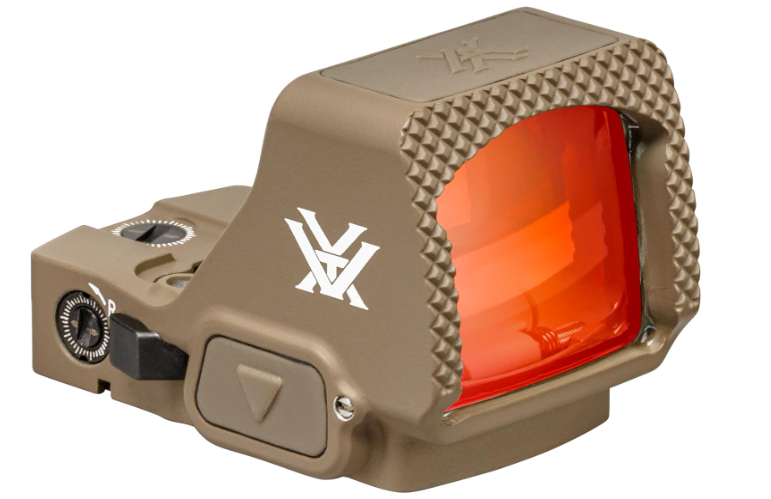
Best Pistol Red Dot for Competition Shooting has become a defining factor in modern competitive handgun performance, where speed, accuracy, and consistency matter more than traditional sight alignment. These optics are designed to replace slower iron sight acquisition with a single, fast visual reference point that allows shooters to engage targets more efficiently under pressure. Their ability to improve target transitions, enhance precision at speed, and reduce visual strain makes them a strong choice for both new and experienced competitors, even though they still demand solid fundamentals to be fully effective.
In this guide, you will find a breakdown of key features that actually matter in competition use, along with a review of top performing optic options currently available. It also covers a practical buying guide to help you avoid overvaluing unnecessary features and focus on real performance impact. Finally, a set of frequently asked questions will address common doubts so you can make a more informed and realistic choice instead of relying on marketing claims or assumptions.
5 Best Pistol Red Dot for Competition Shooting
1.Vortex Defender-XL Micro Dot Sights
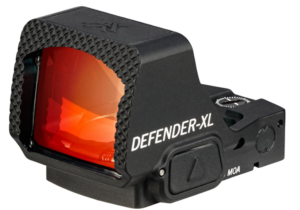
The Vortex Defender XL Micro Red Dot Sight from Vortex Optics is designed with competition use in mind, especially shooters who prioritize speed in target transitions and rapid follow up shots. It uses a very wide viewing window that improves situational awareness, but this also pushes the sight toward a slightly larger footprint compared to more compact competition optics. That tradeoff matters because in competitive shooting every gram and every obstruction on the slide can influence balance and recoil tracking.
A key design choice is the oversized sight window combined with a 2 MOA red dot option, which gives precise aiming for tight scoring zones while still allowing fast visual pickup under pressure. The motion activation system is meant to conserve power and reduce manual handling, but in a competition setting it introduces a dependency on movement to wake the optic. That is useful in theory, yet some shooters may find it unnecessary complexity when consistency and predictability are more important than automation.
Durability is another major focus. The housing uses aluminum construction with added shock protection elements and lens coating intended to resist abrasion. The optic is also rated for water and impact resistance, which is essential for outdoor stages and rough handling during matches. However, durability features often add weight and bulk, and competitive shooters who already run compensated pistols or extended magazine setups may notice the extra mass more than they expect.
Battery management is handled through a top loaded CR2032 system, which allows replacement without fully removing the optic. That is a practical advantage during maintenance, but it can still be inconvenient if battery access interferes with mounted accessories or tight slide configurations. The claimed battery life is strong under moderate brightness settings, yet real world competition use at higher brightness levels can reduce that significantly.
The adjustment system includes multiple brightness settings with night vision compatibility, though most competitors will only use daylight settings. The interface is straightforward, but button lock features can slow down quick adjustments between stages if not configured properly.
Key Specifications
| Specification | Detail |
|---|---|
| Brand | Vortex Optics |
| Model | Defender XL Micro Red Dot Sight |
| Reticle | 2 MOA Red Dot |
| Material | Aluminum |
| Weight | 1.93 oz |
| Dimensions | 2 in x 1.4 in x 1.4 in |
| Mounting System | Slide compatible mounting footprint style |
| Brightness Settings | 12 levels including night vision modes |
| Battery Type | CR2032 top loaded |
| Battery Life | Up to 25,000 hours at medium setting |
| Activation | Motion activated with auto shutoff option |
| Lens Protection | Abrasion resistant coating |
| Weather Resistance | Water and shock resistant |
| Warranty | Lifetime transferable coverage |
Pros
- Wide sight window improves fast target acquisition and tracking
- 2 MOA dot supports precision scoring on small targets
- Motion activation helps conserve battery when not in use
- Top battery access simplifies replacement without full dismount
- Strong durability rating for recoil and rough handling
- Clear lens coating helps maintain visibility in bright conditions
Cons
- Larger optic profile may affect slide balance and handling speed
- Motion activation can feel unnecessary or inconsistent for some shooters
2. Vortex Defender-ST Micro Dot Sights
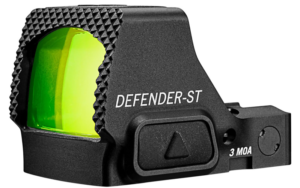
The Vortex Defender ST Micro Red Dot Sight from Vortex Optics is positioned as a more versatile optic that tries to bridge competition use, defensive carry, and general shooting applications. Compared to larger competition focused models, it uses a slightly more compact window, which improves balance on lighter pistols but reduces some of the ultra wide field advantage that pure competition shooters often prefer. That trade is important because it directly affects how fast you can visually track transitions between multiple targets.
A 3 MOA reticle option gives a balanced approach between precision and speed. It is not as fine as smaller dots used for extreme accuracy work, but it remains fast to pick up during rapid fire strings. The lens system is aspherical with hard coating, which reduces distortion and helps maintain a clear sight picture under different lighting conditions. This improves consistency, but it still depends heavily on shooter presentation quality, meaning it will not compensate for poor draw mechanics.
Motion activation with auto shutoff is built in to extend battery life, but its usefulness in competition is debatable. In high tempo stages where the optic is constantly in use, sleep and wake features become irrelevant. They can even introduce uncertainty if the optic does not wake instantly under pressure. On the positive side, the system does reduce battery drain during downtime, which is useful for shooters who leave optics mounted between sessions.
Durability is strong for its size category. Aluminum construction, shock protection inserts, and lens coating make it suitable for repeated recoil exposure and rough handling during transport. However, it is not as overbuilt as larger dedicated competition optics, so long term abuse on heavy slide setups may still show wear faster than bulkier alternatives.
Battery access is handled through a top mounted CR2032 system, which is practical for maintenance without removing the sight. This is useful, but still requires awareness because improper sealing or rushed replacement can introduce reliability issues. Battery life claims are solid under moderate settings, but real world competition brightness settings tend to shorten that window significantly.
Key Specifications
| Specification | Detail |
|---|---|
| Brand | Vortex Optics |
| Model | Defender ST Micro Red Dot Sight |
| Reticle | 3 MOA Green or Red Dot options |
| Material | Aluminum |
| Weight | 0.6 lb |
| Dimensions | Compact micro optic form factor |
| Mounting System | DeltaPoint Pro footprint with Picatinny adapter support |
| Brightness Settings | 12 levels |
| Battery Type | CR2032 top loaded |
| Battery Life | Up to 25,000 hours at medium setting |
| Activation | Motion activation with auto shutoff |
| Lens Type | Aspherical hard coated lens |
| Weather Resistance | Waterproof and shockproof |
| Warranty | Lifetime transferable coverage |
Pros
- Balanced size that works for competition, carry, and general use
- 3 MOA dot offers a middle ground between speed and precision
- Clear aspherical lens reduces distortion and improves sight clarity
- Motion activation helps preserve battery during inactivity
- Top battery access simplifies maintenance without full removal
- Strong durability for a compact optic platform
Cons
- Motion activation adds complexity without major benefit in match use
- Less forgiving for shooters who rely on very wide sight windows
3. Trijicon SRO Sight Adjustable LED 5.0 MOA Red Dot, Black
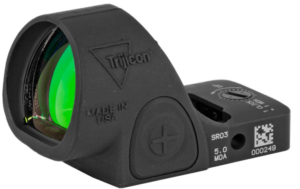
The Trijicon SRO from Trijicon is widely regarded as a pure competition focused optic, and it shows in nearly every design decision. The most important element is the large, open window that prioritizes fast visual tracking over compact concealment. That design choice makes it significantly easier to pick up targets during transitions, especially in dynamic stages where speed matters more than tight carry profiles.
A 5.0 MOA red dot is intentionally larger than what precision oriented shooters typically use, but in competition shooting this becomes an advantage rather than a drawback. The bigger dot is easier to find during recoil and faster to reacquire between shots. The tradeoff is reduced precision at longer distances or smaller targets, but in most pistol competition formats, that limitation is rarely decisive compared to speed loss from a smaller dot.
The sight picture is extremely clean due to the high quality lens and simple reticle design. There are no unnecessary overlays or distractions, which helps shooters maintain focus under pressure. However, this simplicity also means fewer features compared to more modern competition optics. There is no motion activation or battery saving automation, so it relies entirely on manual control and consistent battery management.
Durability is a strong point. The aluminum housing is built to handle repeated recoil and competitive use without drifting zero. The adjustment system is straightforward, with tool less windage and elevation changes, which makes zeroing faster but also means adjustments are more exposed compared to more sealed systems. That can matter in harsh environments or long term rough handling.
Battery life is not the strongest aspect of this optic. Since it does not rely heavily on power saving automation, it requires more consistent user discipline in switching off the optic when not in use. That is a clear contrast with motion activated competitors, and it can be a disadvantage for shooters who want a “leave it on” system.
Key Specifications
| Specification | Detail |
|---|---|
| Brand | Trijicon |
| Model | SRO Adjustable LED Red Dot |
| Reticle | 5.0 MOA Red Dot |
| Material | Aluminum |
| Weight | 1.6 oz |
| Objective Lens Diameter | 20 mm |
| Mounting System | RMR footprint compatible |
| Adjustment | Tool less windage and elevation |
| Field of View | Large window design for competition use |
| Magnification | 1x |
| Brightness | Adjustable LED illumination |
| Compatibility | Handgun red dot platforms |
| Country of Origin | USA |
Pros
- Extremely large window improves target tracking speed
- 5.0 MOA dot is fast to acquire during recoil recovery
- Very clear sight picture with minimal visual clutter
- Strong recoil durability and proven competition reliability
- Simple controls reduce operational confusion under stress
- Fast and easy zero adjustment system
Cons
- No motion activation or automatic power saving features
- 5.0 MOA dot reduces precision for small or distant targets
4. HOLOSUN 407C/507C-X2 Series, 2 MOA Dot, 32 MOA
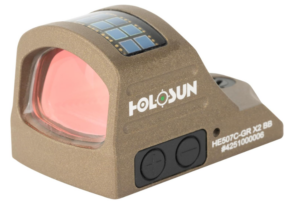
The HOLOSUN 507C X2 from Holosun is one of the most practical competition oriented pistol optics because it focuses on efficiency rather than simplicity or brute durability alone. It uses a compact open emitter design with a relatively large viewing window for its class, which makes target transitions faster without pushing the optic into oversized competition only territory. That balance is exactly why many competitive shooters adopt it as a “do everything” race capable sight rather than a single purpose tool.
The multi reticle system is the main performance advantage. You can switch between a 2 MOA dot or a circle dot combination, which changes how the eye tracks movement under recoil. The circle dot is especially useful in fast stages because it naturally draws the eye back to center, while the 2 MOA dot gives more precise hold on smaller targets. This flexibility is useful, but it also introduces decision fatigue if a shooter constantly switches settings instead of committing to one setup and mastering it.
Solar failsafe and shake awake features make it one of the most battery efficient optics in this category. The system reduces the risk of dead battery failure and minimizes manual activation steps, which is useful for shooters who leave optics mounted for long periods. However, in pure competition environments, these automation features are less important than consistent readiness. Some shooters also find that relying on sleep wake systems can feel less predictable compared to a constant always on optic.
Durability comes from a 7075 aluminum housing, which is stronger than many competitors in the same weight class. It handles recoil well and maintains zero under repeated use. The side mounted battery tray is a practical advantage because it avoids full dismounting during replacement, but it is still a small mechanical point of failure compared to simpler sealed designs.
The optic is lightweight and compact, which helps maintain slide balance on full size pistols used in competition. However, its smaller window compared to dedicated race optics means it does not offer the same extreme field of view as larger competition specific models. That tradeoff is important because faster target acquisition is often driven more by window size than electronic features.
Key Specifications
| Specification | Detail |
|---|---|
| Brand | Holosun |
| Model | 507C X2 Series |
| Reticle | 2 MOA Dot or 32 MOA Circle Dot |
| Material | 7075 T6 Aluminum |
| Weight | 1.44 oz |
| Window Size | 0.63 x 0.91 in |
| Mounting System | RMR footprint |
| Battery Type | CR1632 side tray |
| Power Source | Solar and battery dual system |
| Battery Life | Up to 50,000 hours |
| Brightness Settings | 10 daylight, 2 night vision |
| Adjustment | 1 MOA per click |
| Features | Shake Awake, Solar Failsafe, Lock Mode |
| Compatibility | Handgun platforms |
Pros
- Multi reticle system improves adaptability for different stage styles
- Very strong battery life with solar assist and shake awake system
- Lightweight design helps maintain fast slide cycling
- Durable 7075 aluminum construction handles recoil well
- Side battery tray allows easier replacement without removing optic
- Good balance of size, speed, and feature set for competition use
Cons
- Multiple reticle options can distract or complicate setup choices
- Sleep wake system may feel less predictable than always on optics
5. Aimpoint ACRO™ P-2 Red Dot Reflex Sight 3.5 MOA
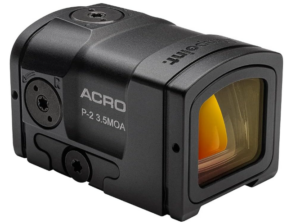
The Aimpoint ACRO P2 from Aimpoint is built with a different priority than most competition oriented pistol optics. Instead of focusing on maximum field of view or lightweight race design, it prioritizes absolute reliability through a fully enclosed emitter system. That makes it extremely resistant to environmental interference, which is useful in outdoor stages, but it also introduces a bulkier footprint that can feel less agile on a fast cycling competition pistol.
The 3.5 MOA dot sits in a middle ground between precision and speed. It is small enough to hold accuracy on tighter targets, yet still visible during rapid recoil movement. However, compared to larger 5 MOA competition dots, it does not draw the eye as aggressively, which can slightly slow down initial dot acquisition for shooters who rely heavily on visual snap during transitions.
The enclosed optic design is its biggest strength. It eliminates issues like emitter blockage from dust, rain, or debris, which can shut down open reflex systems under harsh conditions. This makes it highly dependable across unpredictable environments. The downside is that the housing adds weight and visual obstruction around the edges of the window, which reduces the open sighting feel that most competition shooters prefer for speed focused stages.
Battery life is a major advantage. With up to 50,000 hours, it is effectively a long term always on system that minimizes maintenance concerns. This reduces cognitive load for shooters, since there is no need to manage activation modes or frequent battery checks. However, the simplicity comes at the cost of flexibility, since it lacks modern automation features like motion wake systems found in newer optics.
Durability is where this optic clearly separates itself. It is submersible, shock resistant, and designed for extreme use cases beyond competition shooting. That level of overengineering ensures stability under recoil, but it also creates a heavier optic that can influence slide balance more than lighter race oriented designs.
Key Specifications
| Specification | Detail |
|---|---|
| Brand | Aimpoint |
| Model | ACRO P2 Red Dot Reflex Sight |
| Reticle | 3.5 MOA Red Dot |
| Material | Aluminum |
| Weight | 4.96 oz |
| Dimensions | 1.9 x 1.2 x 1.2 in |
| Mounting System | ACRO platform compatible |
| Emitter Design | Fully enclosed system |
| Battery Type | CR2032 |
| Battery Life | Up to 50,000 hours |
| Waterproof Rating | Submersible up to 35 meters |
| Magnification | 1x |
| Usage Category | Handgun reflex sight |
Pros
- Fully enclosed emitter provides maximum environmental protection
- Extremely durable and reliable under harsh conditions
- Long 50,000 hour battery life supports always on usage
- 3.5 MOA dot balances precision and visibility
- Stable zero retention under heavy recoil
- Low maintenance operation with minimal user intervention
Cons
- Smaller field of view compared to open window race sights
- Overbuilt design adds unnecessary weight for competition only use
Also Read: Best Red Rot Scope for Deer Hunting
Also Read: Best Red Dot for Shotgun Deer Hunting
Advantages of Best Pistol Red Dot for Competition Shooting
1. Faster target acquisition under pressure
A competition red dot removes the need to align front and rear irons, which cuts down visual processing time. In real match conditions, that translates to faster first shot engagement. The limitation is that this speed advantage only appears if your presentation is consistent. If your draw is sloppy, the dot simply exposes the error faster instead of fixing it.
2. Improved transition speed between targets
With a red dot, your eyes stay focused on the target instead of the sights, allowing quicker shifts between multiple targets. This is where competition optics shine most. However, this benefit collapses if the shooter “chases the dot” instead of driving the gun aggressively between targets.
3. Greater precision at speed
A single focal point makes it easier to confirm alignment at distance or on small scoring zones. A 2 MOA or similar dot allows tighter holds than many iron sight setups under time pressure. The downside is that precision only matters if trigger control is already solid; otherwise, the dot just shows your inconsistency more clearly.
4. Better performance in awkward shooting positions
Competition stages often force partial targets, lean-outs, or unstable stances. A red dot allows you to maintain accuracy without perfect sight alignment. Still, this advantage depends heavily on training under those exact conditions, not just equipment choice.
5. Reduced visual fatigue during long stages
Iron sights demand constant alignment focus, which can tire the eyes over long matches. A red dot simplifies visual workload by presenting a single aiming point. That said, poor brightness settings or cheap optics can introduce glare or bloom that negates this benefit.
6. Faster learning curve for new competitors
New shooters generally adapt faster to a red dot than traditional iron sight discipline because the feedback is immediate. You either see the dot or you don’t. But this simplicity can also create bad habits, especially overreliance on the optic instead of proper grip and trigger fundamentals.
7. Improved consistency across different lighting conditions
Modern competition red dots maintain visibility across varied lighting through adjustable brightness systems. This consistency helps across indoor and outdoor stages. The weakness is overdependence on electronics, meaning dead batteries or incorrect brightness settings can suddenly become performance failures.
8. Higher ceiling for performance in speed shooting
At advanced levels, red dots enable faster splits and cleaner transitions because they reduce visual alignment constraints. This is where top competitors gain real advantage. But it’s not the optic alone; without high level recoil control and indexing skills, the theoretical ceiling never gets reached.
Factors to Consider When Choosing the Best Pistol Red Dot for Competition Shooting
1. Window size and sight picture clarity
A larger viewing window makes it easier to pick up the dot quickly and track it through recoil. This directly impacts transition speed between targets. However, chasing the biggest window possible can backfire by adding weight and bulk, which slows down slide movement and can make the pistol feel less balanced.
2. Dot size and reticle design
Smaller dots improve precision at distance, while larger dots are faster to acquire during rapid fire. Some systems add circle overlays to guide the eye back to center. The mistake is assuming more options equals better performance. In reality, inconsistent reticle choices often slow down skill development.
3. Durability under recoil and handling stress
Competition use is not gentle. Repeated recoil cycles, drops, and rough handling during stage changes all stress the optic. A weak housing will shift zero or fail entirely under pressure. But overbuilt designs can add unnecessary weight that negatively affects speed, so durability must be balanced, not maximized blindly.
4. Mounting system compatibility
A secure and stable mounting interface is critical because even minor movement between optic and slide destroys consistency. Compatibility also affects how easily the optic integrates with your pistol platform. Choosing the wrong footprint leads to unreliable fitment or added adapter complexity, which introduces more failure points.
5. Battery life and power management
Long battery life reduces mental load during competition season. Systems that require constant manual attention or frequent battery changes increase failure risk. However, relying too heavily on “always on” assumptions without discipline can still lead to dead optic situations at the worst possible moment.
6. Activation and control system design
How the optic turns on, adjusts brightness, and locks settings directly affects usability under stress. Simple systems reduce mistakes, while automated systems reduce maintenance. The tradeoff is predictability versus convenience, and in competition, unpredictability is often more damaging than inconvenience.
7. Weight and slide balance impact
Every gram added to the slide affects recoil behavior and cycling speed. A heavier optic can slow transitions and change how the pistol tracks during rapid fire. On the other hand, ultra-light designs may sacrifice durability, so the goal is controlled balance rather than minimum weight.
8. Optical clarity and distortion control
A clear, distortion-free lens allows faster visual processing and reduces eye strain during long stages. Poor clarity slows down target recognition and can cause inconsistent dot tracking. However, clarity alone does not fix poor shooting mechanics, it only makes existing performance easier to repeat.
Frequently Asked Questions About Best Pistol Red Dot for Competition Shooting
1. Do I really need a red dot for competition shooting
A red dot is not mandatory, but it significantly changes how fast you can engage targets and transition between them. It reduces the need for sight alignment, which shortens visual processing time. The downside is that it exposes poor fundamentals quickly, so without proper grip and draw mechanics, the advantage is limited.
2. What dot size works best for competition use
Smaller dots offer better precision at distance, while larger dots are easier to pick up during fast shooting. Many competitors settle in the middle because extreme choices force unnecessary tradeoffs. The real issue is not dot size itself but consistency in how quickly you can find and track it under recoil.
3. Are enclosed optics better than open emitter designs for competition
Enclosed systems protect against dirt, rain, and debris, which improves reliability in harsh environments. However, they often reduce the open viewing experience that helps with faster target transitions. In competition, speed usually benefits more from a wide, unobstructed window than from environmental sealing alone.
Conclusion
Best Pistol Red Dot for Competition Shooting comes down to one core reality: speed and consistency matter more than feature overload. Across all the options discussed, the real advantage of these optics is how they remove visual alignment friction and allow the shooter to focus entirely on target transitions, recoil control, and decision making under pressure. The larger windows, refined reticles, and improved clarity systems all serve the same purpose, faster visual confirmation and reduced time between shots. However, none of these optics compensate for weak fundamentals, they only amplify what the shooter already has.
What separates the stronger choices in this category is how well they balance speed, durability, and simplicity without adding unnecessary complexity. Features like motion activation, enclosed emitters, or multi reticle systems can be useful, but they are secondary to how quickly the dot appears and how stable it remains under recoil. In competition shooting, the best optic is not the most advanced one on paper, but the one that disappears in use and lets performance take over without distraction or delay.