

Best Telescope for Stargazing is what they are designed for, because most beginners do not fail due to lack of interest, but due to choosing equipment that does not match real observing conditions. These telescopes are great for stargazing because they balance light gathering power, optical clarity, and usability, which directly affects how well users can see the Moon, planets, and brighter deep sky objects. Many entry level users get distracted by high magnification claims, but real performance depends more on aperture size, stable mounting, and how easily the system can be controlled under the night sky.
In this guide, they will find a breakdown of the key features that matter most, along with top picks based on real world performance rather than marketing numbers. It will also cover a practical buying guide to help them understand what actually matters when choosing a telescope instead of relying on guesswork. Finally, it will include FAQs to clear up common confusion and help them avoid the mistakes most beginners make when starting out in astronomy.
7 Best Telescopes for Stargazing
1. Gskyer Telescope, 70mm Aperture 400mm AZ Mount Astronomical Refracting Telescope for Kids Beginners – Travel Telescope with Carry Bag, Phone Adapter and Wireless Remote.
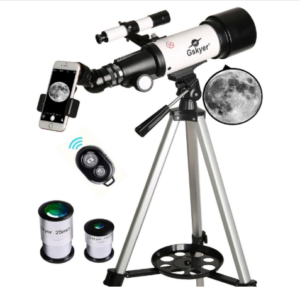
The Gskyer 70mm Aperture 400mm Astronomical Refracting Telescope is one of the most popular beginner telescopes for casual astronomy and family stargazing. It is designed for people who want an affordable and portable telescope that is simple to set up and easy to use. With its 70mm aperture and 400mm focal length, it delivers clear views of the moon, bright planets, and larger star clusters without becoming overly complicated for first time users.
This telescope works especially well for beginners because it balances portability, image quality, and ease of operation. The fully coated optical glass improves light transmission, helping users see brighter and sharper celestial objects during nighttime viewing sessions. The refractor design also requires very little maintenance compared to reflector telescopes, making it a practical option for kids, students, and hobbyists who want a straightforward stargazing experience.
One of the strongest advantages of this telescope is the included accessory package. Gskyer includes two eyepieces, a 3x Barlow lens, a smartphone adapter, and a wireless camera remote. This allows users to experiment with different magnification levels and even capture basic moon photos using a smartphone. For beginners interested in astrophotography, the phone adapter adds extra value without increasing the learning curve too much.
The adjustable aluminum tripod helps users find comfortable viewing angles while keeping the telescope lightweight enough for travel. The included carry bag makes transport and storage easier, especially for camping trips or backyard astronomy sessions. Since the telescope uses an altazimuth mount, movement feels intuitive and beginner friendly during object tracking.
Image quality is respectable for the price range. The telescope performs best when viewing the moon, brighter planets such as Jupiter and Saturn, and large deep sky objects. Lunar craters appear detailed under good viewing conditions, while Jupiter’s larger moons are visible with proper magnification. However, expectations should remain realistic because this is still an entry level telescope rather than a high end astronomy instrument built for advanced astrophotography or extremely distant galaxies.
Key Specifications
| Specification | Details |
|---|---|
| Brand | Gskyer |
| Model | Astronomical Refracting Telescope |
| Aperture | 70mm |
| Focal Length | 400mm |
| Focal Ratio | f/5.7 |
| Mount Type | Altazimuth |
| Optical Design | Refractor |
| Focus Type | Manual Focus |
| Finder Scope | 5×24 |
| Eyepieces Included | Two |
| Barlow Lens | 3x |
| Tripod Material | Aluminum Alloy |
| Smartphone Adapter | Yes |
| Wireless Remote | Yes |
| Carry Bag | Yes |
| Product Dimensions | 24.8 x 4.92 x 8.46 inches |
| Rating | 4.3 out of 5 stars |
Pros
- Easy to assemble and use
- Good image clarity for beginners
- Lightweight and portable design
- Includes several useful accessories
- Suitable for kids and adults
- Affordable price for entry level astronomy
Cons
- Limited performance for deep space viewing
- Tripod stability could be better
2. Celestron StarSense Explorer LT 114AZ App-Enabled Telescope – 114mm Newtonian Reflector with Smartphone Dock & StarSense App – iPhone & Android Compatible – Easy-to-Use for Beginners
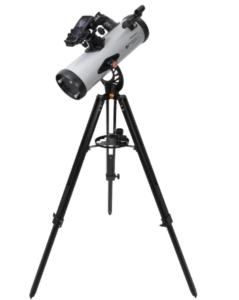
The Celestron StarSense Explorer LT 114AZ is a beginner friendly reflector telescope designed to remove one of the biggest frustrations in amateur astronomy: finding objects in the night sky. Most entry level telescopes fail because beginners spend more time searching for planets and stars than actually observing them. Celestron solves that problem by integrating smartphone assisted navigation with its StarSense Explorer app, making this telescope far more approachable for new users.
This telescope combines a 114mm Newtonian reflector with app guided sky navigation, giving users a much easier path into stargazing. Once the smartphone is docked and connected through the StarSense system, the app analyzes star patterns overhead and guides the user toward visible celestial targets using on screen arrows. Instead of randomly scanning the sky, beginners can quickly locate planets, star clusters, nebulae, and galaxies with far less confusion.
The 114mm aperture is a major upgrade over smaller beginner telescopes. It gathers significantly more light, allowing brighter and more detailed views of objects such as the Moon, Jupiter, Saturn, the Orion Nebula, and the Andromeda Galaxy. Lunar craters appear sharp and detailed, while Saturn’s rings and Jupiter’s cloud bands become easier to observe under good viewing conditions. Compared to smaller 70mm refractor models, this telescope offers noticeably better deep sky performance.
Celestron includes 25mm and 10mm eyepieces, giving users different magnification options straight out of the box. The manual altazimuth mount remains beginner friendly while also including a slow motion adjustment rod for smoother tracking. This improves the viewing experience when following moving objects across the night sky, especially during longer observation sessions.
The StarSense app is the biggest selling point of this telescope, but it is also where expectations need balance. The system works very well for beginners who struggle with celestial navigation, yet it also creates some dependence on smartphone usage. People expecting a fully traditional astronomy experience may prefer manual star hopping methods instead. In addition, the app experience depends partly on phone compatibility and battery life during extended outdoor sessions.
Key Specifications
| Specification | Details |
|---|---|
| Brand | Celestron |
| Model | StarSense Explorer LT 114AZ |
| Optical Design | Newtonian Reflector |
| Aperture | 114mm |
| Optical Tube Length | 24 inches |
| Mount Type | Altazimuth |
| Focus Type | Manual Focus |
| Eyepieces Included | 25mm and 10mm |
| Smartphone Compatibility | iPhone and Android |
| Navigation System | StarSense App |
| Finder Scope | Reflex |
| Product Dimensions | 36 x 36 x 57 inches |
| Power Source | Manual |
| Rating | 4.2 out of 5 stars |
Pros
- Excellent for beginners learning the night sky
- Smartphone guidance simplifies object finding
- Stronger deep sky performance than small refractors
- Sharp planetary and lunar views
- Smooth tracking adjustments
- Large 114mm aperture gathers plenty of light
Cons
- More expensive than basic beginner telescopes
- Requires smartphone for full StarSense experience
3. Dianfan Telescope,90mm Aperture 800mm Telescopes for Adults Astronomy,Portable Professional Refractor Telescope for Beginners,with Stainless Tripod & Phone Adapter,Carry Bag
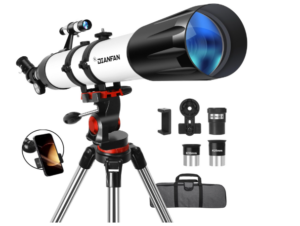
The Dianfan 90mm Aperture 800mm Refractor Telescope is built for beginners and casual astronomy enthusiasts who want stronger viewing performance without stepping into overly expensive advanced telescope territory. With its larger 90mm aperture and longer 800mm focal length, this telescope delivers brighter and more detailed views than many smaller entry level models, making it a solid option for lunar, planetary, and daytime observation.
This refractor telescope focuses heavily on image clarity and ease of use. The fully coated 90mm objective lens improves light transmission and contrast, helping users observe sharper details on the Moon and brighter planets. The larger aperture gathers more light than typical beginner telescopes, which improves visibility during nighttime stargazing sessions and makes celestial objects appear clearer under decent sky conditions.
One of the stronger aspects of this telescope is its magnification flexibility. The included eyepieces and 3x Barlow lens provide a magnification range from 32x to 240x. Lower magnification works well for wide sky viewing and star clusters, while higher magnification allows closer observation of lunar craters and planetary details. The included 45 degree zenith mirror also provides upright and correctly oriented images, making the telescope useful for terrestrial viewing such as birdwatching and wildlife observation.
The telescope is designed with beginners in mind, and that becomes obvious during setup. Clear instructions and a straightforward assembly process make it easier for first time users to get started without frustration. Smooth manual focusing helps users quickly adjust image sharpness while tracking celestial targets.
Portability is another practical advantage. The lightweight optical tube pairs with a stainless steel tripod that offers better stability than many aluminum tripod systems found in cheaper telescopes. The included carry bag also makes transportation and storage more convenient for travel, camping, or backyard astronomy sessions.
The telescope performs best when observing the Moon, brighter planets, and larger celestial objects. Lunar details appear crisp under favorable conditions, while Jupiter and Saturn become visible with noticeable detail at moderate magnification levels. However, like many beginner refractors, extremely high magnification settings may reduce image brightness and sharpness, especially under poor atmospheric conditions.
Key Specifications
| Specification | Details |
|---|---|
| Brand | Dianfan |
| Model | 90800 |
| Optical Design | Refractor |
| Aperture | 90mm |
| Focal Length | 800mm |
| Mount Type | Altazimuth |
| Focus Type | Manual Focus |
| Eyepiece Type | Kellner |
| Magnification Range | 32x to 240x |
| Finder Scope | Straight Through |
| Smartphone Compatibility | Yes |
| Tripod Material | Stainless Steel |
| Carry Bag Included | Yes |
| Product Dimensions | 31 x 11 x 5 inches |
| Rating | 4.4 out of 5 stars |
Pros
- Bright and sharp image quality
- Larger aperture improves light gathering
- Stable stainless steel tripod
- Beginner friendly assembly process
- Versatile for both astronomy and daytime viewing
- Portable and travel friendly
Cons
- High magnification can soften image quality
- Manual tracking takes practice
4. MEEZAA Telescope, Telescope for Adults High Powered Professional, 90mm Aperture 800mm Refractor Telescopes for Astronomy Beginners Fully Multi-Coated with AZ Mount Tripod & Phone Adapter & Carry Bag
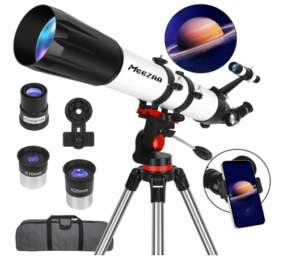
The MEEZAA 90mm 800mm Refractor Telescope is designed for beginners who want stronger astronomical performance without dealing with overly technical equipment. Many entry level telescopes sacrifice image quality for portability or low cost, but this model attempts to provide a more balanced experience by combining a larger 90mm aperture, long 800mm focal length, and beginner friendly setup process.
This refractor telescope performs particularly well for lunar and planetary observation. The 90mm aperture gathers enough light to produce brighter and clearer images than smaller beginner telescopes, while the fully multi coated optics improve contrast and image sharpness. Under good viewing conditions, users can observe detailed lunar craters, Jupiter’s moons, and Saturn’s rings with satisfying clarity.
The 800mm focal length also helps improve detail at medium and higher magnification levels. MEEZAA includes two eyepieces and a 3x Barlow lens, allowing a magnification range from 32x to 240x. Lower magnification works better for viewing larger star clusters and scanning the night sky, while higher settings bring planetary details closer into view. Like most beginner telescopes, extremely high magnification settings may reduce sharpness if atmospheric conditions are poor, so realistic expectations still matter.
One area where this telescope performs well is overall usability. Setup is straightforward, with many users able to assemble it in around 10 minutes using the included instructions. The manual altazimuth mount remains beginner friendly because movement feels natural during target tracking. The adjustable stainless steel tripod also offers better stability than the lightweight aluminum tripods commonly found in cheaper telescope packages.
The included phone adapter adds extra value for beginners interested in basic astrophotography. Users can attach a smartphone to capture moon photos or short planetary videos without needing expensive dedicated camera equipment. While the results will not compete with professional astrophotography setups, the feature makes astronomy more interactive and enjoyable for casual users.
Portability is another practical advantage. The telescope and accessories fit neatly into the included carry bag, making it suitable for camping trips, backyard astronomy, and travel. The design balances portability and optical capability reasonably well, although it is still larger than compact travel telescopes.
Key Specifications
| Specification | Details |
|---|---|
| Brand | MEEZAA |
| Model | 90800 |
| Optical Design | Refractor |
| Aperture | 90mm |
| Focal Length | 800mm |
| Focal Ratio | f/8.88 |
| Mount Type | Altazimuth |
| Focus Type | Manual Focus |
| Eyepieces Included | 10mm and 25mm |
| Magnification Range | 32x to 240x |
| Finder Scope | Straight Through |
| Smartphone Compatibility | Yes |
| Tripod Material | Stainless Steel |
| Carry Bag Included | Yes |
| Product Dimensions | 32 x 6 x 10.24 inches |
| Rating | 4.4 out of 5 stars |
Pros
- Bright and detailed lunar views
- Easy setup process for beginners
- Stable stainless steel tripod
- Good optical clarity for the price
- Portable for travel and outdoor use
- Smartphone adapter adds versatility
Cons
- Manual tracking can be challenging at high magnification
- Deep sky viewing remains somewhat limited
5. Hawkko Telescope, 90mm Aperture 900mm Astronomical Refractor Telescope for Adults High Powered – Multi-Coated Professional Telescopes for Astronomy Beginners with AZ Mount, Carry Bag, Phone Adapter
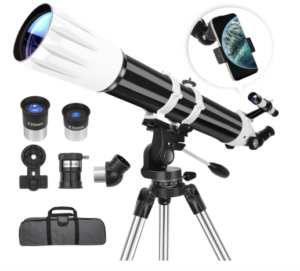
The Hawkko 90mm 900mm Astronomical Refractor Telescope is aimed at beginners and casual astronomy enthusiasts who want stronger magnification and improved image clarity without entering the high cost advanced telescope market. Its combination of a 90mm aperture and longer 900mm focal length makes it better suited for detailed lunar and planetary viewing than many smaller beginner telescopes.
This telescope delivers a more balanced astronomy experience because the longer focal length improves image control at medium and higher magnifications. Many cheaper beginner telescopes advertise extreme magnification numbers but fail to maintain sharpness. The Hawkko model performs more realistically by pairing its 90mm aperture with fully multi coated optics designed to improve brightness, contrast, and image detail.
The optical performance is one of its strongest areas. Lunar craters appear sharp and well defined under good conditions, while Jupiter and Saturn become easier to observe with noticeable planetary detail. The fully multi coated lens system improves light transmission significantly, helping create brighter and clearer images during nighttime observation. Compared to entry level 70mm telescopes, the larger aperture gathers more light and produces a noticeably better viewing experience.
The telescope includes two eyepieces and a 3x Barlow lens, producing a magnification range from 36x to 270x. Lower magnification settings work best for wider sky viewing and locating celestial objects, while moderate magnification levels provide the clearest planetary observation. Like most beginner telescopes, pushing toward maximum magnification can reduce image sharpness and brightness, especially in poor atmospheric conditions.
The stainless steel altazimuth tripod adds practical stability during observation sessions. Smooth 360 degree movement and adjustable height controls make it easier for beginners to track objects across the sky without overly complicated adjustments. The mount remains simple enough for first time users while still providing better control than very lightweight entry level tripod systems.
Portability is another useful advantage. The telescope comes with a carry bag and accessory tray, making storage and transportation easier for camping trips, outdoor stargazing, and backyard astronomy. The included smartphone adapter also allows users to capture basic moon and planet images using a mobile phone, which adds extra appeal for beginners interested in casual astrophotography.
Setup is relatively straightforward and can usually be completed within 15 minutes. However, as with many manual telescopes, beginners may need some practice learning how to align objects and maintain stable tracking at higher magnification levels. Deep sky viewing remains somewhat limited compared to larger reflector telescopes, though brighter nebulae and star clusters are still visible under dark skies.
Key Specifications
| Specification | Details |
|---|---|
| Brand | Hawkko |
| Model | Telescope 90900 |
| Optical Design | Refractor |
| Aperture | 90mm |
| Focal Length | 900mm |
| Focal Ratio | f/10 |
| Mount Type | Altazimuth |
| Focus Type | Manual Focus |
| Eyepieces Included | 25mm and 10mm |
| Magnification Range | 36x to 270x |
| Finder Scope | Straight Through |
| Smartphone Compatibility | Yes |
| Tripod Material | Stainless Steel |
| Carry Bag Included | Yes |
| Product Dimensions | 36 x 6 x 10 inches |
| Rating | 4.3 out of 5 stars |
Pros
- Sharp lunar and planetary views
- Longer focal length improves image control
- Stable stainless steel tripod
- Beginner friendly setup process
- Portable design for outdoor use
- Good accessory package included
Cons
- Maximum magnification is less practical in real conditions
- Manual tracking requires patience
- Deep sky performance has limitations
- Larger size reduces compact portability
6. Koolpte Telescope 80mm Aperture 600mm – Astronomical Portable Refracting Telescope Fully Multi-Coated High Transmission Coatings AZ Mount with Tripod Phone Adapter, Wireless Control, Carrying Bag.
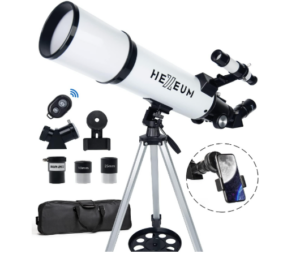
The Koolpte 80mm 600mm Astronomical Refracting Telescope is positioned as a budget friendly entry point for beginners who want a simple, portable telescope without paying premium prices. It focuses more on ease of use and accessibility than raw optical power, which makes it suitable for casual stargazing, kids, and first time astronomy users who mainly want to observe the Moon and bright celestial objects.
The 80mm aperture is modest but still capable of gathering enough light for basic night sky observation. It performs best when viewing the Moon, where craters and surface textures become clearly visible under stable conditions. Bright planets such as Jupiter and Saturn can also be observed, though with limited detail compared to larger 90mm or 114mm telescopes. The 600mm focal length keeps the design compact and improves portability, but it also limits long range magnification clarity.
Optically, the telescope uses fully multi coated lenses to improve light transmission and image brightness. This helps reduce some of the softness typically seen in lower cost refractors. However, the smaller aperture means it still struggles in low light deep sky conditions, especially when attempting to observe faint galaxies or nebulae. It is fundamentally a “starter experience” telescope rather than a serious deep space instrument.
The included eyepieces and 3x Barlow lens provide a magnification range from 24x to 180x. Lower magnification is the most practical setting for beginners, especially when learning how to locate objects in the sky. Higher magnification is available, but image quality tends to drop as magnification increases beyond moderate levels. This is normal for entry level refractors and should not be mistaken for a defect, but it does limit advanced use.
One of the strongest selling points of the Koolpte telescope is its portability and accessory package. The lightweight design, adjustable tripod, carry bag, smartphone adapter, and wireless remote make it easy to transport and set up quickly. The wireless remote is a useful addition at this price range because it helps reduce vibration when capturing images, improving basic astrophotography results with a phone.
Setup is extremely beginner friendly and requires no tools, which is a clear advantage for first time users. The altazimuth mount keeps movement simple and intuitive, although it does not provide the tracking precision needed for long observation sessions at high magnification. Overall, this telescope is not designed for advanced astronomy or detailed deep sky exploration. It is best viewed as a learning tool and entry point into stargazing, where simplicity and affordability matter more than optical depth.
Key Specifications
| Specification | Details |
|---|---|
| Brand | Koolpte |
| Optical Design | Refractor |
| Aperture | 80mm |
| Focal Length | 600mm |
| Focal Ratio | f/6.7 |
| Mount Type | Altazimuth |
| Focus Type | Manual Focus |
| Eyepieces Included | 25mm and 10mm |
| Magnification Range | 24x to 180x |
| Finder Scope | 5×24 |
| Smartphone Compatibility | Yes |
| Wireless Remote | Yes |
| Tripod Material | Aluminum Alloy |
| Carry Bag Included | Yes |
| Product Dimensions | 19.29 x 5.31 x 8.27 inches |
| Rating | 4.3 out of 5 stars |
Pros
- Very easy to assemble and use
- Lightweight and highly portable
- Affordable entry level price
- Includes useful smartphone and remote accessories
- Good for Moon and bright planet viewing
- Compact design ideal for travel
Cons
- Limited aperture restricts deep sky performance
- High magnification loses sharpness quickly
7. Telescope 150EQ Astronomical Professional Telescope for Adults High Powered, Manual Equatorial Reflector Telescopes for Beginners with Phone Adapter, Moon Filter, Stainless Tripod – with Carrying Bag
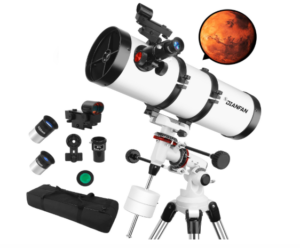
The Dianfan 150EQ is a serious step up from beginner level telescopes, aimed at users who want noticeably stronger light gathering power and more detailed views of deep sky objects. With its large 150mm aperture and equatorial mount system, it targets enthusiasts who are ready to move beyond casual stargazing and into more structured astronomy observation. That said, it is also where many beginners overestimate what they are ready for, so expectations need to stay grounded.
The biggest strength of this telescope is its 150mm aperture. This is a meaningful jump compared to 80mm or 90mm refractors because it collects significantly more light. That translates into brighter images, better contrast, and improved visibility of faint celestial objects. The 650mm focal length keeps the system relatively wide field, which is useful for scanning star clusters, nebulae, and large sky regions rather than only focusing on planets.
Optically, the reflector design delivers strong performance for deep sky viewing. Under good conditions, users can observe clearer details in objects like the Orion Nebula, star clusters, and brighter galaxies. Lunar observation is also sharp, showing detailed craters and surface structures. However, like most reflectors in this class, collimation adjustments are required occasionally, which can be frustrating for beginners who expect a plug and play experience.
The equatorial mount is both a strength and a weakness. On one hand, it allows smoother and more precise tracking of celestial objects once properly aligned, which is essential for longer observation sessions. On the other hand, it has a learning curve that many beginners underestimate. Setup takes around 20 minutes, but real mastery of polar alignment and slow motion controls takes time and patience. This is not a casual grab and go telescope.
Magnification ranges from 26x to 130x using the included eyepieces and 2x Barlow lens. This range is realistic and usable, avoiding the common beginner mistake of advertising extreme magnification that the optics cannot support. Lower magnification is best for deep sky scanning, while mid range settings provide the sharpest planetary detail. High magnification becomes sensitive to atmospheric conditions and stability, which is normal for reflectors of this size.
The build package is strong for its category. It includes a stainless steel tripod, red dot finder, smartphone adapter, and a large carrying bag. The tripod provides stable support, but the overall system is heavy and not ideal for frequent travel. At over 14 kg with the case, portability is more about transport than convenience.
Key Specifications
| Specification | Details |
|---|---|
| Brand | Dianfan |
| Model | 150EQ |
| Optical Design | Newtonian Reflector |
| Aperture | 150mm |
| Focal Length | 650mm |
| Mount Type | Equatorial Mount (EQ) |
| Focus Type | Manual Focus |
| Eyepieces Included | Two |
| Barlow Lens | 2x |
| Magnification Range | 26x to 130x |
| Finder Scope | Red Dot Finder |
| Tripod Material | Stainless Steel |
| Smartphone Compatibility | Yes |
| Carrying Bag Included | Yes |
| Product Weight (with bag) | 14 kg |
| Product Dimensions | 35.4 x 9.4 x 13.9 inches |
| Height Range | 48.4 to 66.2 inches |
| Rating | 4.2 out of 5 stars |
Pros
- Strong light gathering capability
- Excellent deep sky viewing potential
- Stable equatorial tracking system
- Good lunar and planetary detail
- Complete accessory package included
- More realistic magnification range than many beginner scopes
Cons
- Steep learning curve for equatorial mount
- Heavy and less portable than smaller models
Also Read: Best Spotting Scope
Advantages of Using a Telescope for Stargazing
1. Strong Light Gathering for Clearer Space Views
A telescope is fundamentally about collecting light, not just magnifying objects. The larger the aperture, the more light it gathers, which directly improves brightness and detail. This is why small entry level scopes struggle with faint objects while larger ones reveal more structure.
2. Sharper Detail on the Moon and Planets
A proper telescope turns the Moon from a bright circle into a detailed surface filled with craters, ridges, and shadow lines. Planets like Jupiter and Saturn also become more meaningful, showing moons, bands, and rings under stable conditions. The key limitation is atmospheric stability, not just the telescope itself. Many beginners wrongly blame equipment when the real issue is viewing conditions.
3. Access to Deep Sky Objects
Without a telescope, most deep sky objects are invisible. With one, star clusters, nebulae, and some galaxies become detectable. Larger aperture telescopes improve this significantly by capturing more faint light. However, expectations need to stay realistic. Deep sky objects will not look like colorful photos online because those are long exposure images.
4. Improved Target Location with Assisted Systems
Modern telescopes can reduce the difficulty of finding objects in the sky. Smartphone guided systems and reflex finders help users point the telescope accurately without advanced knowledge of star maps. This is a major advantage for beginners because traditional navigation is often the biggest barrier. T
5. Better Tracking Stability for Observation
A stable mount is critical for viewing at higher magnification. Good telescopes reduce shaking and allow smoother tracking of moving objects as the Earth rotates. Equatorial mounts improve this even further by following celestial motion more precisely.
6. Flexibility for Different Types of Viewing
Different telescope designs support different observation styles. Some are better for wide sky scanning, others for detailed planetary work. This flexibility allows users to choose what they want to focus on instead of being limited to one type of object. However, no single telescope does everything perfectly.
7. Portability Versus Performance Balance
Smaller telescopes are easier to carry, set up, and use quickly. Larger telescopes offer better image quality but are heavier and more complex. This creates a direct tradeoff between convenience and performance. Many beginners underestimate this and end up with equipment they rarely use because it is too bulky or time consuming to set up.
8. Long Term Skill Development
A telescope is not just a viewing tool but a learning system. Simpler models teach basic observation skills, while more advanced systems like reflectors and equatorial mounts develop deeper astronomy knowledge. The advantage is long term growth potential, but only if the user is willing to learn. n too early.
From all the above discussions, the Best Telescope for Stargazing stands out not because of extreme specifications, but because of how well it balances aperture size, optical clarity, stability, and ease of use. These telescopes are great for stargazing because they allow users to realistically observe the Moon, planets, and brighter deep sky objects without overwhelming complexity or unrealistic expectations. The real value comes from how much usable detail they can deliver under real night sky conditions, not from inflated magnification claims or marketing hype.
Overall, the strongest options are the ones that match performance with user skill level. A well chosen telescope provides clear lunar detail, recognizable planetary features, and a meaningful introduction to deep sky observation. When users prioritize aperture, stable mounting, and practical usability, they get a far more rewarding astronomy experience that builds long term interest rather than frustration.