
Table of Contents
ToggleBest Air Rifles for Field Target and Training Shooting are designed for shooters who demand precision, consistency, and control at varying distances where small errors can cost accuracy. These rifles stand out because they combine regulated air systems, accurate barrels, and refined trigger mechanisms that help deliver repeatable shot performance in outdoor and competitive settings. Unlike general purpose airguns, they are built to minimize recoil and improve stability, making them more reliable for hitting small targets under real field conditions. Their value lies in how well they maintain accuracy over multiple shots rather than simply producing high power.
In this guide, you will find a clear breakdown of key features that define effective field target rifles, along with top picks based on performance and usability. It also covers a practical buying guide to help you choose the right setup depending on your skill level and shooting goals. Finally, a detailed FAQ section addresses common questions to help you avoid mistakes and make informed decisions when selecting a rifle for field target shooting.
5 Best Air Rifles for Field Target and Training Shooting
1. Hatsan BullBoss QE Air Rifle

The Hatsan BullBoss QE PCP Air Rifle bundle is a powerful entry in the field of precision air rifles, designed for shooters who want raw energy, quiet operation, and a complete starter package. For field target shooting, it brings a mix of high velocity performance and practical usability, but it also pushes beyond what many competitive shooters typically prefer in tightly controlled precision formats.
This rifle uses a pre charged pneumatic system paired with a 230cc removable air cylinder, giving it strong shot capacity and consistent air delivery when properly maintained. The Quattro trigger system allows adjustable pull characteristics, which is important for precision shooting disciplines like field target where trigger control directly affects accuracy. The rotary magazine and side lever action make follow up shots smooth and relatively fast, reducing disruption between targets. The QuietEnergy shrouded barrel system reduces report significantly, making it more suitable for outdoor ranges and semi residential environments.
Where this rifle becomes controversial for field target shooting is in its power profile. With up to 1100 feet per second and 46 foot pounds of energy, it is significantly more powerful than many traditional field target setups that prioritize lower, more stable energy outputs for consistency and reduced pellet deviation. While power is impressive, field target success depends more on shot consistency than raw force, and this is where the BullBoss QE may require careful tuning and disciplined pellet selection to avoid overdriving performance.
At 9.5 pounds, the rifle is not light, and that weight can be a disadvantage in long shooting sessions where stability matters more than power. On the positive side, the weight does help reduce movement during aim, but it may fatigue younger or smaller shooters. Overall, this is a rifle that leans more toward versatile hunting and long range shooting that can be adapted to field target use rather than being purpose built for it.
Key Specifications
| Specification | Detail |
|---|---|
| Platform | PCP air rifle |
| Caliber options | 5.6 mm (.22) and .25 |
| Air cylinder | 230cc removable |
| Maximum velocity | 1100 fps with lead pellets |
| Maximum energy | 46 FPE |
| Trigger system | Quattro adjustable trigger |
| Magazine type | Rotary magazine |
| Action type | Side lever |
| Barrel system | QuietEnergy shrouded barrel |
| Weight | 9.5 pounds |
| Rail system | 11 mm and 22 mm combo rail |
| Shots per fill | Approximately 35 at optimal velocity |
Pros
- High power output suitable for long distance target engagement
- Quiet operation due to integrated sound moderation system
- Adjustable trigger improves control for precision shooting
- Good shot capacity from removable air cylinder
- Smooth side lever cycling supports faster follow up shots
Cons
- Power level is excessive for strict field target efficiency and may reduce consistency
- Heavy build can cause fatigue during extended competitions
- May require careful tuning and pellet testing to achieve tight groupings
2. Gamo Coyote Whisper Fusion PCP Air Rifle
The Gamo Coyote Whisper Fusion PCP Air Rifle is built around a light, fast handling platform that prioritizes speed and ease of use over heavyweight competition precision tuning. For field target shooting, it sits in an interesting middle ground because it combines a match style barrel with a multi shot system, but it also carries design choices that lean more toward hunting efficiency than strict competition discipline.
This rifle operates on a pre charged pneumatic system and uses a 10 shot repeater mechanism, which allows quick follow up shots without manual reloading between targets. That is useful in informal field target practice where speed matters, but in formal field target shooting it can be a drawback since most competitors prefer single shot loading for maximum consistency and pellet alignment. The press to load system cycles efficiently and supports a steady rhythm, but it introduces more moving parts compared to single load match rifles.
Accuracy potential is supported by a full floated match quality barrel and a two stage adjustable trigger. These two elements are important for field target shooting because they directly influence shot control and repeatability. The .177 caliber option is also well aligned with field target standards since it provides flatter trajectories and better precision at distance. However, the extremely light weight of about 2 pounds raises concerns about stability. In field target shooting, a slightly heavier rifle often performs better because it reduces wobble and improves hold consistency during long aiming periods.
The wood stock gives it a more traditional feel, and the overall build makes it comfortable for quick positioning. Still, some of its construction choices such as mixed material barrel design raise questions about long term durability under heavy competitive use. It performs well as a fast handling PCP rifle, but it does not fully commit to the slow precision oriented nature of serious field target competition setups.
Key Specifications
| Specification | Detail |
|---|---|
| Platform | Pre charged pneumatic air rifle |
| Caliber options | .177 and .22 |
| Magazine capacity | 10 shot rotary system |
| Barrel type | Match quality full floated barrel |
| Trigger system | Two stage adjustable trigger |
| Stock material | Wood |
| Frame material | Metal |
| Barrel material | Plastic composite |
| Action type | Multi shot repeater system |
| Dimensions | 42.9 inches length |
| Weight | 2 pounds |
| Power type | PCP |
Pros
- Fast 10 shot system supports quick target transitions
- Match quality barrel improves potential accuracy
- Two stage adjustable trigger allows better shot control
- Light handling makes it easy to carry and position quickly
- .177 caliber option suits field target trajectory needs
Cons
- Very light weight reduces stability for precision field target shooting
- Multi shot system is less consistent than single load setups for competition accuracy
- Ultra light build raises concerns for long term durability under heavy use
3. Umarex Notos Carbine .22 Caliber PCP Pellet Gun Air Rifle

The Umarex Notos Carbine .22 Caliber PCP Air Rifle is a compact, regulated platform that leans heavily toward controlled precision shooting rather than raw power. For field target shooting, this is where it becomes more relevant than many budget PCP rifles because it prioritizes consistency through a regulated air system and a short, maneuverable carbine layout.
This rifle uses a fixed high pressure air tank with a built in regulator, which is one of the most important elements for field target performance. Regulation reduces velocity fluctuation between shots, and that consistency is what separates casual PCP rifles from those that can actually perform well on precision targets at varying distances. The 11.75 inch barrel keeps the rifle compact, but that shorter barrel also means it is relying more on efficient air use and regulation rather than barrel length for velocity consistency. It produces around 700 fps with 12 grain pellets, which is moderate and easier to manage for predictable trajectory control.
The 7 shot auto indexing magazine supports quick follow up shots, but like other multi shot systems, it is not the ideal setup for strict competition where single load discipline is often preferred for maximum precision. The side lever action is smooth and allows fast cycling without breaking shooting position, which is useful in timed field target lanes. At 5 pounds, the rifle strikes a reasonable balance between stability and maneuverability, giving it enough weight to steady aim without becoming tiring during extended sessions.
Where the Notos Carbine stands out is in its regulated shot consistency and compact design combination. Many rifles in this price and size range struggle to maintain shot-to-shot uniformity, but this one is built specifically to solve that problem. However, it is still limited by its short barrel and smaller power curve, meaning it performs best at moderate field target distances rather than extreme long range precision work.
Key Specifications
| Specification | Detail |
|---|---|
| Platform | Pre charged pneumatic (PCP) |
| Caliber | .22 |
| Barrel length | 11.75 inches |
| Velocity | Approximately 700 fps (12 grain pellets) |
| Magazine capacity | 7 shot rotary magazine |
| Action type | Side lever |
| Air system | Fixed regulated high pressure tank |
| Frame material | Metal |
| Barrel material | Metal |
| Weight | 5 pounds |
| Use case | Target shooting, plinking, small game |
Pros
- Regulated air system improves shot-to-shot consistency for field target accuracy
- Compact carbine design is easy to handle in tight shooting positions
- Smooth side lever action supports fast follow up shots
- Balanced weight helps stabilize aim without causing fatigue
- Consistent moderate velocity is easier to tune for predictable trajectory
Cons
- Short barrel limits long range precision potential compared to longer PCP rifles
- Multi shot magazine is less ideal than single load systems for competition accuracy
- Limited power ceiling restricts performance at extended field target distances
4. Sig Sauer MCX Virtus PCP Pellet Air Rifle
The Sig Sauer MCX Virtus PCP Pellet Air Rifle is a semi automatic style platform that prioritizes speed, tactical handling, and training realism more than traditional field target precision. For field target shooting, it enters the discussion in a different way compared to classic bolt action PCP rifles because it emphasizes rapid engagement rather than single shot discipline.
This rifle runs on a pre charged pneumatic system and uses a 30 round Rapid Pellet Magazine, which allows continuous shooting without manual loading after every shot. That feature is useful for training scenarios and reactive target practice, but it becomes a liability in serious field target competition where consistency, pellet seating uniformity, and controlled shot execution matter more than speed. The semi automatic cycling also introduces more mechanical movement during firing, which can slightly reduce the repeatable stability that field target shooters usually depend on.
At 7.5 pounds, the rifle has enough weight to feel stable in the shoulder, but its plastic heavy frame design raises questions about long term rigidity compared to full metal precision PCP rifles. The 17.5 inch barrel provides a reasonable balance between velocity and control, but again the platform is not optimized for extreme precision shooting at varying field target distances. Instead, it is designed to mimic firearm style handling, making it more suitable for training and tactical style target shooting.
The inclusion of flip up sights and an M1913 rail system shows its focus on modular training setups rather than pure competition accuracy. While it can be used for target shooting, its strengths are clearly in rapid engagement and familiarization rather than the slow, deliberate precision required in field target disciplines.
Key Specifications
| Specification | Detail |
|---|---|
| Platform | Pre charged pneumatic (PCP) |
| Caliber | .22 |
| Magazine capacity | 30 round Rapid Pellet Magazine |
| Action type | Semi automatic |
| Barrel length | 17.5 inches |
| Sights | Flip up front and rear sights |
| Rail system | M1913 accessory rail |
| Frame material | Synthetic plastic |
| Barrel material | Synthetic plastic |
| Weight | 7.5 pounds |
| Stock type | Synthetic tactical stock |
| Use case | Training, plinking, reactive target shooting |
Pros
- High capacity 30 round magazine supports fast target engagement
- Semi automatic operation allows rapid follow up shots
- Heavier weight improves shoulder stability during firing
- Modular rail system supports optics and accessories
- Good for training scenarios that require speed and repetition
Cons
- Semi automatic system reduces precision consistency for field target shooting
- Plastic heavy construction is less rigid than dedicated competition PCP rifles
- Not optimized for single shot accuracy required in serious field target events
5. Barra TPR 1200 and 1300 Air Rifle for Hunting

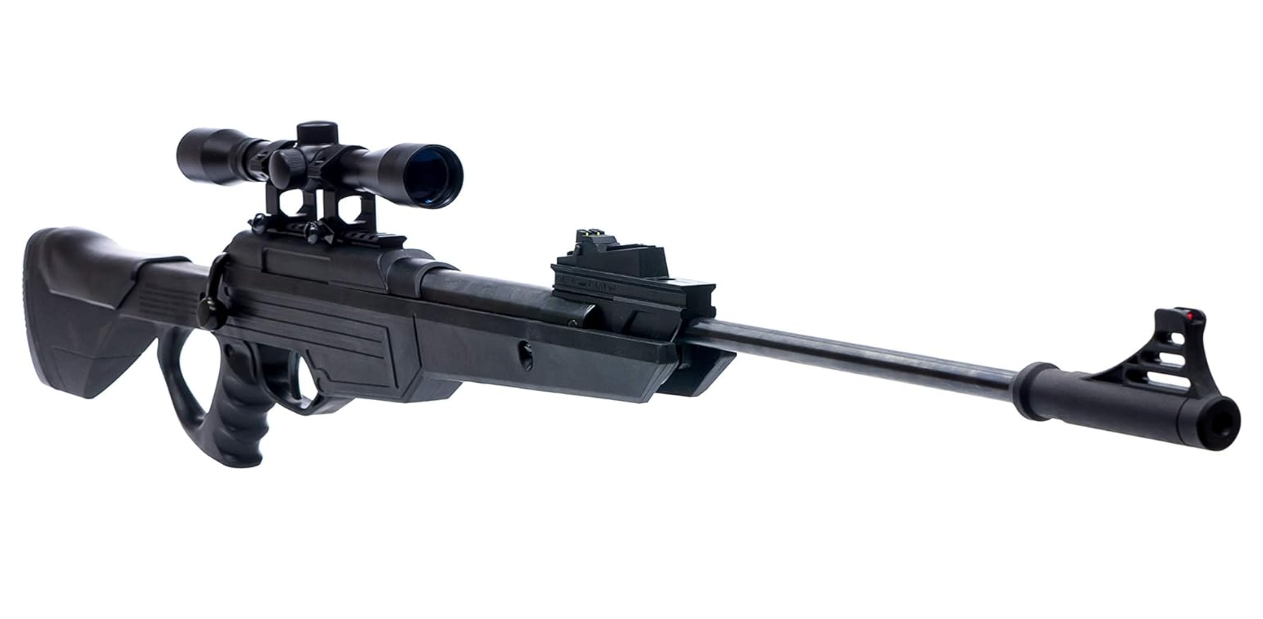
The Barra TPR 1200 and 1300 Break Barrel Spring Piston Rifles represent the most traditional style of air rifle in this field target shooting comparison. Unlike PCP systems that rely on stored compressed air for consistency, this platform depends on mechanical spring energy, which immediately places it in a different category when it comes to precision shooting disciplines.
This rifle delivers up to 1300 fps in .177 caliber, which sounds impressive on paper but does not automatically translate into field target accuracy. Spring piston systems generate noticeable recoil and vibration at the moment of firing, and that movement directly affects shot consistency. In field target shooting, where millimeter level precision matters, even small inconsistencies in follow through can cause significant misses at distance. The 18 inch rifled barrel does help stabilize pellet flight, but it cannot fully compensate for the internal movement created by the spring mechanism.
The single shot loading system is actually one of the few advantages for field target use. It forces a disciplined shooting routine, which aligns with competition style expectations. The included 4×32 scope also provides a basic entry level setup, though serious field target shooters would typically upgrade optics for better clarity and adjustable parallax control. At 8 pounds, the rifle has decent mass, which helps reduce felt recoil slightly, but it also adds fatigue during longer sessions.
Where this rifle struggles most is repeatability. Spring piston rifles are inherently more sensitive to hold technique, meaning the same shooter can produce different results simply based on grip pressure or shoulder position. That level of inconsistency is a major drawback in field target environments where predictability is more important than raw power.
Key Specifications
| Specification | Detail |
|---|---|
| Platform | Spring piston break barrel |
| Caliber | .177 |
| Maximum velocity | Up to 1300 fps |
| Barrel length | 18 inches rifled steel barrel |
| Action type | Single shot break barrel |
| Scope | 4×32 included |
| Frame material | Plastic |
| Barrel material | Alloy steel |
| Weight | 8 pounds |
| Power source | Mechanical spring piston |
| Use case | Target shooting, small game hunting |
Pros
- Single shot system supports disciplined field target shooting routine
- High velocity output provides strong pellet trajectory performance
- Rifled barrel improves basic shot stability
- No need for air tanks or CO2 refills reduces running costs
- Heavier build helps reduce some recoil movement
Cons
- Spring recoil reduces shot-to-shot consistency for precision field target shooting
- Highly sensitive to shooting technique makes accuracy harder to repeat
- Less suitable for competition level precision compared to PCP rifles
Also Read: Best Air Rifle for Hunting Raccoon
Also Read: Best Air Rifle to Kill Groundhogs
Advantages of Best Air Rifles for Field Target and Training Shooting
1. High Precision Potential with Proper Platforms
Field target rifles, especially PCP models, can deliver very tight shot groups when properly tuned. Their stable air delivery and quality barrels help maintain accuracy at varying distances. This makes them suitable for hitting small targets consistently. However, performance depends heavily on choosing the right setup.
2. Strong Shot-to-Shot Consistency in PCP Systems
PCP rifles offer consistent pressure per shot, reducing velocity variation. This leads to more predictable pellet flight and better accuracy. Regulated systems improve this further by stabilizing output. Consistency is a major advantage over spring powered rifles.
3. Reduced Recoil for Better Control
PCP air rifles produce minimal recoil, keeping the sight picture stable after firing. This helps shooters track shots and maintain position. Less movement improves accuracy, especially in precision shooting. Spring rifles cannot match this level of stability.
4. Adjustable Trigger Systems Improve Accuracy
Adjustable triggers allow shooters to fine tune pull weight and break point. This reduces unwanted movement during firing. A clean trigger break improves shot consistency. It is essential for precision focused shooting like field target.
5. Multi Shot Capability Increases Efficiency
Many rifles include magazines that allow multiple shots without reloading. This speeds up target engagement and improves shooting rhythm. It is useful for practice and informal field courses. However, it is less precise than single shot setups.
6. Compact Designs Improve Handling in Field Conditions
Compact rifles are easier to carry and position in different shooting stances. This improves comfort during outdoor use. They are quicker to aim and adjust between targets. The trade off can be reduced stability in some cases.
7. Built in Regulation Enhances Long Range Predictability
Regulated PCP systems keep air pressure stable across shots. This reduces vertical deviation at longer distances. It improves confidence when aiming at varied field target ranges. Shooters spend less time correcting for inconsistencies.
8. Versatility Across Training and Competition Use
These rifles can be used for both practice and recreational shooting. They allow shooters to build skills while still being usable in field target style setups. This makes them cost effective compared to specialized competition rifles. However, they may not reach elite competition performance levels.
Factors to Consider When Choosing Best Air Rifles for Field Target and Training Shooting
1. Power Consistency and Regulation
Consistency of air pressure is one of the most important factors in field target shooting. A regulated system ensures each shot is delivered with the same energy, reducing velocity fluctuations that affect accuracy. Without stable pressure, pellet trajectory becomes unpredictable at longer distances. This consistency is more important than raw power when precision is the goal.
2. Trigger Quality and Adjustability
A good trigger system directly affects shooting accuracy because it controls how cleanly the shot is released. Adjustable two stage triggers are preferred since they allow customization of pull weight and travel. Poor trigger control can easily throw off aim, especially at small targets. A predictable break improves repeatability across multiple shots.
3. Barrel Quality and Length
The barrel plays a key role in stabilizing pellet flight. A well rifled and properly aligned barrel improves accuracy and reduces shot deviation. Barrel length also influences velocity balance and control, with mid length designs often offering better precision stability. Inconsistent barrels lead to poor grouping regardless of shooter skill.
4. Recoil and Shooting Stability
Low recoil is essential for maintaining sight alignment during and after the shot. Systems with minimal movement allow the shooter to stay on target and analyze impact immediately. High recoil platforms introduce unnecessary movement that reduces precision. Stability is critical for consistent field target performance.
5. Loading System and Shot Control
Single shot systems are often preferred in precision shooting because they ensure careful pellet placement and alignment. Multi shot systems offer speed but can introduce slight inconsistencies. The loading mechanism should support controlled, repeatable shooting habits. Simplicity often improves accuracy in competitive environments.
6. Weight and Balance
Rifle weight affects how steady the shooter can hold aim over time. Heavier rifles tend to offer better stability, while very light rifles can feel unstable in wind or extended aiming. However, excessive weight can cause fatigue. Proper balance between front and rear weight improves control in varied shooting positions.
7. Air Capacity and Shot Count
The size of the air reservoir determines how many consistent shots can be taken before refilling. Larger tanks support longer shooting sessions, while smaller ones require more frequent refills. Shot consistency across the air curve is also important, not just total shot count. Stable performance across all usable shots is essential for field target use.
8. Build Quality and Long Term Reliability
Durability matters because field target rifles are used repeatedly in outdoor conditions. Solid construction ensures consistent alignment and reduces performance drift over time. Weak materials or loose tolerances can affect accuracy after extended use. A reliable build maintains performance across seasons and repeated handling.
Frequently Asked Questions About Best Air Rifles for Field Target and Training Shooting
1. What makes an air rifle suitable for field target shooting?
An air rifle suitable for field target shooting needs high shot-to-shot consistency, low recoil, and strong accuracy potential. Regulated PCP systems are usually preferred because they maintain stable air pressure, which improves precision. A good trigger system and quality barrel also play a major role. Without these features, accuracy becomes inconsistent at varying distances.
2. Is a multi shot air rifle good for field target shooting?
Multi shot rifles can be useful for practice and faster shooting, but they are not always ideal for serious field target competition. Single shot loading is often preferred because it ensures each pellet is seated carefully and consistently. Multi shot systems may introduce slight variations that affect precision. They are better suited for training and casual target shooting than strict competition use.
3. Should beginners use PCP or spring air rifles for field target shooting?
PCP rifles are generally better for beginners in field target shooting because they offer lower recoil and more consistent performance. This makes it easier to learn accuracy fundamentals without fighting mechanical movement. Spring rifles require more technique and are sensitive to hold position, which can frustrate new shooters. PCP systems provide a more stable learning curve for precision shooting development.
Conclusion
Best Air Rifles for Field Target and Training Shooting are defined by one core requirement: controlled precision over raw power. Across the different platforms discussed, the most effective options are those that deliver consistent shot-to-shot performance, minimal recoil, and fine trigger control. PCP systems clearly outperform spring and semi automatic designs because they stabilize pressure output and reduce shooter error, which is critical when engaging small targets at varying distances. Features like regulated air systems, quality barrels, and adjustable triggers consistently separate suitable field target rifles from general purpose airguns.
What makes these rifles effective is not just their specifications but how those specifications work together under precision conditions. Stability, predictable velocity, and disciplined loading systems all contribute to tighter groupings and more repeatable results. While some models prioritize speed or versatility, true field target performance comes from consistency and control. Choosing the right rifle ultimately comes down to prioritizing accuracy systems over convenience features, ensuring the shooter can perform reliably in competitive or practice environments.